
The sections below provide tools for different aspects of faculty evaluation. Explore, and then adopt or adapt any to your campus’s specific needs and cultures.
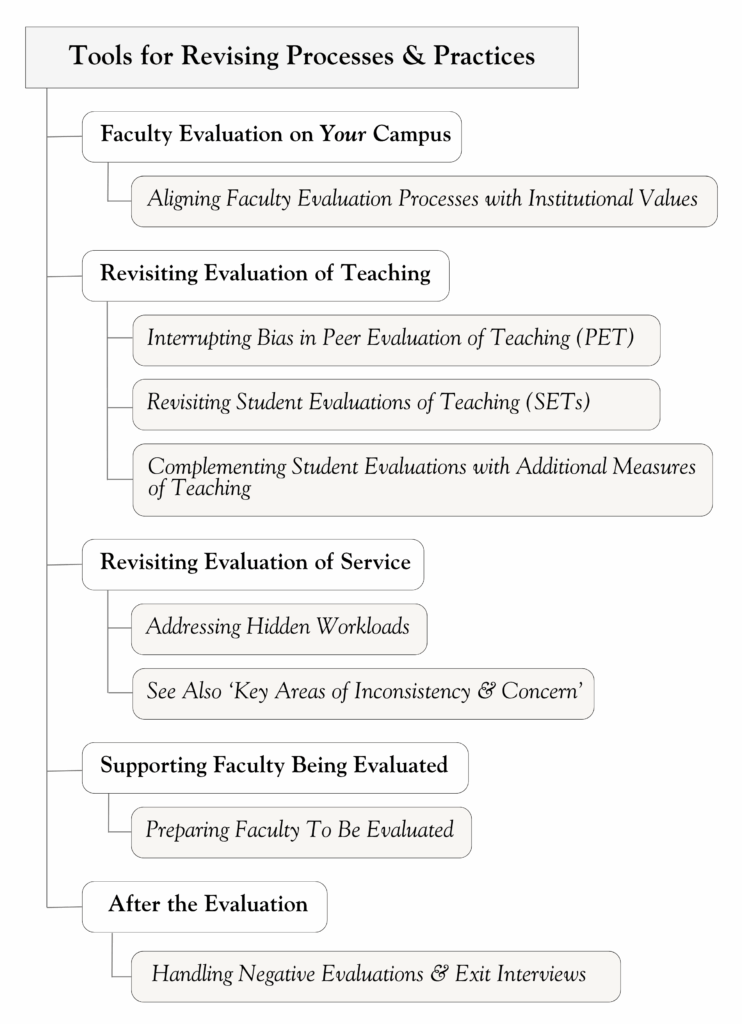
Below, you’ll find specific tools for faculty evaluation organized in five sections.
See the more detailed sitemap of the list of tools by clicking the image to the left, or click here to access the PDF.
Faculty Evaluation on Your Campus
Aligning Faculty Evaluation Processes with Institutional Values
Guidance for institutions to align their faculty evaluation values, processes, and products with their institutional values
Revisiting Evaluation of Teaching
Interrupting Bias in Peer Evaluation of Teaching (PET)
A ready-to-implement workshop to help peer evaluators recognize and interrupt bias when evaluating a peer’s teaching
Revisiting Student Evaluations of Teaching (SETs)
Key concerns with student evaluations of teaching (SETs) and ready-to-implement workshops for reviewing an existing SET or developing a new one
Complementing Student Evaluations with Additional Measures of Teaching
Support for complementing student evaluations of teaching (SETs) with multiple measures of teaching effectiveness
Revisiting Evaluation of Service
Addressing Hidden Workloads
A review of how hidden workloads impact faculty careers and recommendations for surfacing, acknowledging, and valuing invisible labor
See Also ‘Key Areas of Inconsistency & Concern’
Essential cautions and guidance for evaluating service in “Key Areas of Inconsistency & Concern“
Supporting Faculty Being Evaluated
Preparing Faculty to Be Evaluated
Customizable workshops to support faculty members who are being evaluated
After the Evaluation
Handling Negative Evaluations & Exit Interviews
Strategies for handling negative faculty evaluations for pre-tenure and tenured faculty
References
View the bibliography for developing this Toolkit.
The Toolkit was developed as a collaboration across ACS campuses as part of a grant from the Arthur Vining Davis Foundations. To learn more about the grant project, the teams and campuses involved, and the development and piloting of these resources, visit the “About This Project” page.